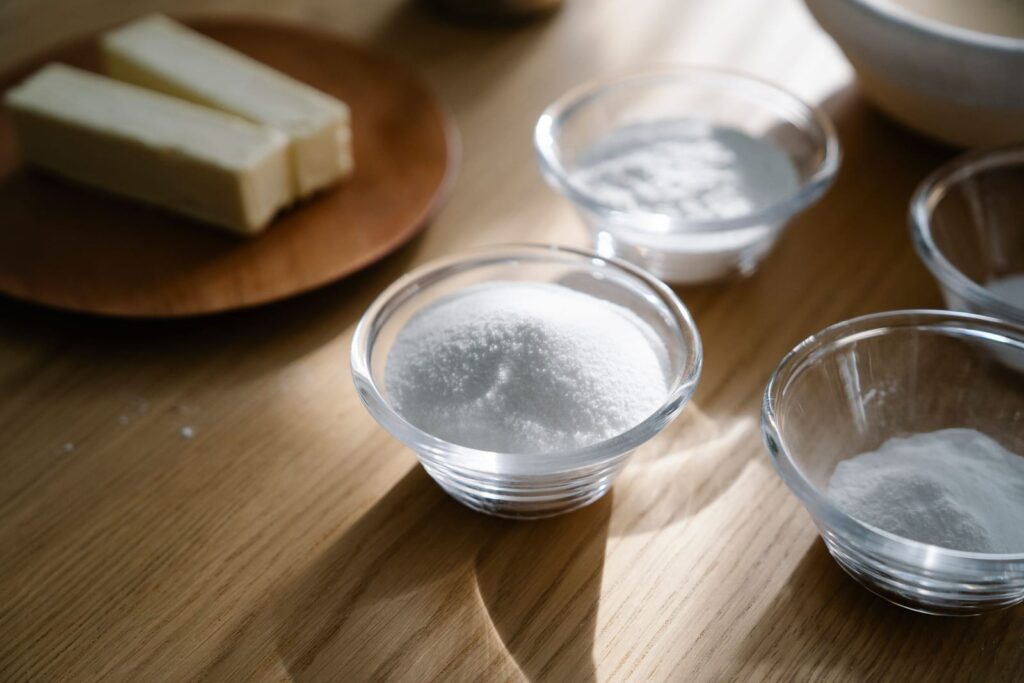
They sit next to each other in the pantry, they are both white powders, and many recipes ask for a spoonful of each. It is no surprise that baking soda and baking powder get mixed up. But they are not the same ingredient, they are not freely interchangeable, and choosing the wrong one is one of the most common reasons a batch of pancakes comes out flat or a cake tastes faintly of soap. Once you understand what each one does, recipes start to make a lot more sense.
Both are chemical leaveners
Yeast makes bread rise slowly, through fermentation. Baking soda and baking powder do the same job in minutes, through chemistry. When a base meets an acid in the presence of moisture, they react and release carbon dioxide. Those tiny bubbles get trapped in the batter, expand in the heat of the oven, and set in place as the batter firms up. That is what gives muffins, cakes, biscuits, cookies and quick breads their lift and open crumb.
The difference between the two products comes down to one question: where does the acid come from?
Baking soda: the base on its own
Baking soda is pure sodium bicarbonate. On its own it is an alkaline salt, and it does very little in a batter unless there is an acid for it to react with. That acid has to come from the recipe itself. Common acidic ingredients include:
- Buttermilk, yogurt and sour cream
- Lemon juice, vinegar and other citrus
- Brown sugar, molasses and honey
- Natural (non-alkalized) cocoa powder
- Chocolate, fruit purees and applesauce
Once soda meets the acid and the liquid, the reaction starts immediately. That is why recipes that rely on soda usually tell you to get the batter into the oven quickly: the bubbles are already forming, and if the batter sits around, some of that lift escapes.
Baking soda also does more than leaven. Because it is alkaline, it encourages browning, which is why a small amount gives cookies a deeper golden color and a slightly crisper edge. It also neutralizes some of the tang of acidic ingredients, softening the sourness of buttermilk in a pancake.
Baking powder: base and acid in one can
Baking powder is baking soda that comes with its own acid already mixed in, plus a dry starch such as cornstarch to absorb moisture and keep the two from reacting in the container. Because the acid is built in, baking powder can leaven a batter that has no acidic ingredients at all, such as a plain vanilla cake made with regular milk.
Most baking powder sold in supermarkets today is double-acting. It contains two acids: one that reacts as soon as the powder gets wet, and a second that only reacts once the batter heats up in the oven. That second burst of gas makes double-acting powder more forgiving, because a batter can rest for a few minutes without losing all of its rise. Single-acting powders, which release all their gas on contact with liquid, were the original type (Alfred Bird created one in England in 1843) and are less common in home kitchens now.
The key differences at a glance
| Baking soda | Baking powder | |
|---|---|---|
| What it is | Sodium bicarbonate only | Sodium bicarbonate plus one or two acids and a starch |
| Needs an acid in the recipe? | Yes | No |
| When it reacts | Immediately, on contact with acid and liquid | Double-acting: when wet, then again when heated |
| Strength | Very strong; small amounts go a long way | Milder; used in larger amounts |
| Typical amount | About 1/4 teaspoon per cup of flour | About 1 teaspoon per cup of flour |
| Effect on flavor and color | Promotes browning; tastes soapy or metallic if overused | More neutral |
Why some recipes use both
It can seem redundant to see both in the same ingredient list, but there is a logic to it. A buttermilk biscuit or a chocolate cake made with natural cocoa has plenty of acid. The baker adds just enough baking soda to neutralize that acid, which balances the flavor and helps browning. But the amount of soda needed to neutralize the acid may not produce enough gas on its own for a light texture, so baking powder is added to top up the lift in a controlled, predictable way.
Can you substitute one for the other?
Replacing baking powder with baking soda: possible, but you have to supply the missing acid. The classic homemade version is 1/4 teaspoon of baking soda plus 1/2 teaspoon of cream of tartar for every 1 teaspoon of baking powder. Mix it just before using, since it behaves like single-acting powder and starts reacting as soon as it gets wet.
Replacing baking soda with baking powder: trickier. Because soda is so much stronger, you would need several times as much baking powder to get the same lift, and that much powder can leave a bitter, chemical taste. It also will not neutralize the acid in the recipe the way soda does, so the result may taste sharper and brown less. It works in a pinch for pancakes or muffins, but for anything where flavor and color matter, it is better to buy the right ingredient.
Self-raising flour, common in the UK, is simply plain flour with baking powder already mixed in. If a recipe calls for it and you only have plain flour, the usual rule of thumb is about 1 teaspoon of baking powder per cup of flour, or roughly 2 teaspoons per 150 grams.
Signs you used too much or too little
- Soapy, metallic or bitter taste: too much baking soda, or not enough acid to neutralize it.
- Dark brown or speckled crumb: excess soda, which also leaves small brown spots where it did not fully dissolve.
- Cake rises high then sinks in the middle: often too much leavener. The bubbles grow too large, merge and collapse before the structure sets.
- Dense, flat, gummy texture: too little leavener, or leavener that has lost its strength.
How to check if yours still works
Both products lose potency over time, especially baking powder once the can has been opened and exposed to humid air. Before a baking project that matters, run a quick test:
- Baking powder: stir half a teaspoon into a few tablespoons of hot water. It should fizz vigorously right away.
- Baking soda: add a quarter teaspoon to a splash of vinegar or lemon juice. Strong bubbling means it is still good.
If either one barely reacts, replace it. A fresh can costs little compared with a ruined cake. Store both tightly sealed in a cool, dry cupboard, away from the steam of the stove.
The takeaway
Baking soda is a strong base that needs an acid from your recipe to do its work, and it reacts the moment the batter comes together. Baking powder carries its own acid, usually reacts twice, and is gentler. Follow the recipe as written when you can, reach for the cream of tartar trick if you run out of powder, and test your leaveners before a big bake. Your pancakes will thank you.