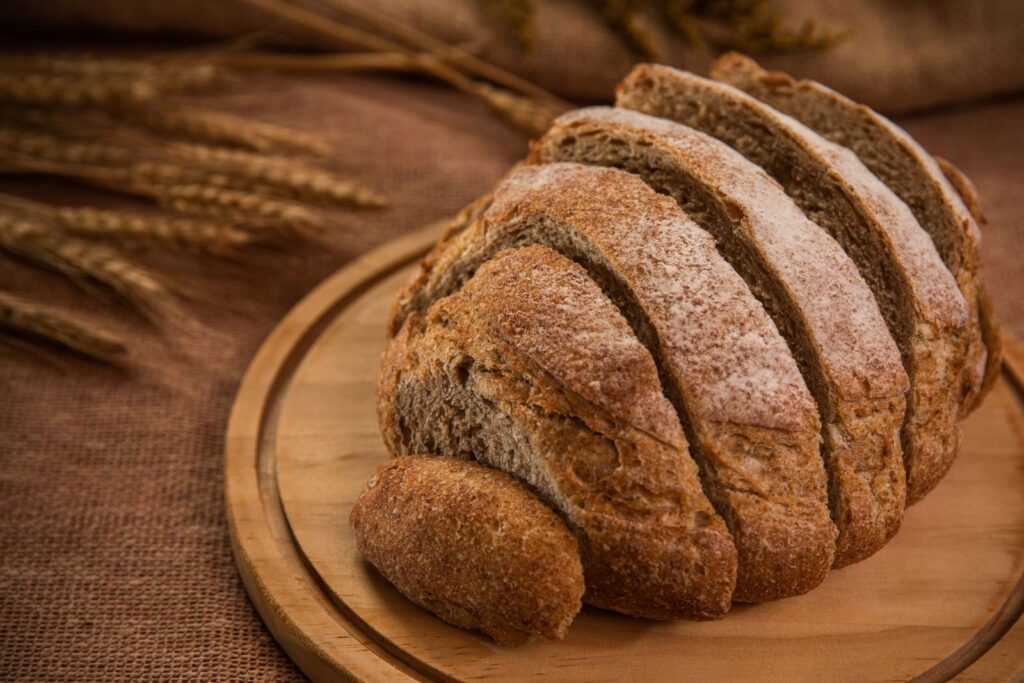
Stand in the bread aisle for a minute and you will see the same promise printed a dozen different ways: wholemeal, wholegrain, whole wheat, multigrain, seeded, “made with whole grains.” They sound interchangeable, and plenty of shoppers treat them that way. They are not. Two of those words describe the flour a loaf is made from, one describes the grains that went into it, and a couple are little more than marketing. Here is how to tell them apart, and which one to reach for depending on what you want from your bread.
What makes a grain “whole”
Every cereal grain, whether wheat, rye, barley, oats or spelt, has three edible parts. The bran is the tough outer layer, and it carries most of the fiber along with B vitamins and minerals. The germ is the small embryo that would sprout into a new plant, rich in healthy fats, vitamin E and more B vitamins. The endosperm is the starchy bulk of the kernel, the food supply for that future plant, and it is mostly carbohydrate with some protein.
White flour is made by milling the grain and sifting away the bran and germ, leaving mainly endosperm. That gives a lighter, softer loaf with a longer shelf life, because the oils in the germ are what turn flour rancid over time. The price is that most of the fiber and a good share of the micronutrients go with it. A grain is “whole” when all three parts stay in the finished product, in roughly the proportions nature put them there.
Wholemeal: a word about flour
Wholemeal is the term used in the UK, Ireland, Australia and New Zealand for flour milled from the entire wheat kernel. In the United States the same product is called whole wheat flour. The two are, for practical purposes, the same thing.
In the UK the word is protected. The Bread and Flour Regulations 1998 define wholemeal flour as flour made from “the whole of the product obtained from the milling or grinding of cleaned cereals,” and regulation 6 bans the word “wholemeal” on any bread unless all of the flour in it is wholemeal. A British loaf labeled wholemeal cannot be a blend of white and brown flour dressed up with a darker color.
The US has a similar rule for whole wheat bread: the federal standard of identity requires that bread sold as “whole wheat” be made with whole wheat flour rather than a mix that includes white flour. Where things get looser is with names like “wheat bread” or “honey wheat,” which can legally be mostly refined flour.
Wholemeal bread tends to be dense, with a fine, even crumb and a nutty, slightly bitter edge from the bran. Because the flour is ground finely, you usually cannot see individual grains in the slice.
Wholegrain: a word about grains
Wholegrain describes the grains rather than a single flour. A wholegrain loaf is built on whole cereal grains, and it may include several of them: wheat alongside rye, oats, barley, spelt or millet, sometimes as flour, sometimes as cracked or whole kernels you can see and bite into. That is why wholegrain bread often looks more textured and speckled than wholemeal.
The catch is that “wholegrain” is far less tightly controlled than “wholemeal.” In the UK there is no legal threshold for calling a bread wholegrain, so a loaf can carry the word while still containing a meaningful amount of white flour. In the US, “made with whole grains” can likewise sit on a product where the whole grain is a minor ingredient.
If you want a quick shortcut in the US, look for the Whole Grain Stamp from the Whole Grains Council. Its 100% Stamp means every grain ingredient is whole grain and a serving provides at least 16 grams of whole grain; the Basic and 50%+ Stamps require at least 8 grams per serving but allow some refined flour.
Side by side
| Wholemeal | Wholegrain | |
|---|---|---|
| What it describes | Flour milled from the whole wheat kernel | Bread built on whole cereal grains, often several kinds |
| Grains used | Usually wheat only | Wheat plus rye, oats, barley, spelt and others |
| Texture | Dense, fine and even crumb | Often chunkier, with visible bits of grain and seed |
| Label protection (UK) | Legally defined: all flour must be wholemeal | No legal minimum |
| US equivalent | Whole wheat | Whole grain, multigrain (check the stamp) |
Which is healthier?
A genuine 100% wholemeal loaf and a genuine 100% wholegrain loaf are nutritional cousins. Both keep the bran and germ, so both deliver far more fiber than white bread, and fiber is the nutrient most adults fall short on. Fiber slows digestion, keeps you full for longer and blunts the blood sugar spike you get from refined starch.
Where they differ is that a wholegrain loaf with a mix of grains and seeds can offer a broader spread of nutrients. Oats bring beta glucan, a soluble fiber linked to lower cholesterol; rye has a particularly high fiber content; seeds like flax and sunflower add healthy fats. The risk runs the other way too: a loaf sold as “wholegrain” or “multigrain” with white flour as its first ingredient may be less nutritious than a plain wholemeal loaf.
So the honest answer is that the label matters less than the ingredient list. Whichever word is on the front, flip the bag over.
How to read the label in ten seconds
- Check the first ingredient. Ingredients are listed by weight. You want to see wholemeal flour, whole wheat flour or a named whole grain first, not “wheat flour” or “enriched flour,” which are white flour.
- Look at the fiber line. A true wholemeal or wholegrain bread usually has noticeably more fiber per slice than white bread. If the number is barely different, the loaf is probably mostly refined.
- Do not trust the color. Brown bread can be colored with malt extract, molasses or caramel. A dark crust tells you nothing about the flour.
- Treat “multigrain” as neutral. It only means more than one grain was used. It says nothing about whether those grains were whole.
- Use the stamp where it exists. In the US the 100% Whole Grain Stamp is the most reliable front of pack signal.
Where sourdough fits in
Sourdough is not a type of flour at all. It is a method of leavening, using a culture of wild yeast and lactic acid bacteria instead of commercial yeast. You can make sourdough from white flour, wholemeal flour or a wholegrain blend, and the long fermentation changes its flavor, texture and how easily some people digest it. We looked at that comparison in detail in Wholemeal versus Sourdough Bread: How are they different? If you enjoy both, a wholemeal sourdough gives you the fiber of the whole kernel with the tang and keeping quality of a slow ferment.
Baking with each at home
If you bake your own bread, the two behave differently in the bowl. Wholemeal flour absorbs more water than white flour because the bran soaks it up, so recipes usually call for a wetter dough and a short rest before kneading to let the bran soften. The sharp edges of bran particles also cut through gluten strands, which is why a 100% wholemeal loaf rises less and stays denser. Many home bakers start with half wholemeal and half strong white flour and work upward from there.
Wholegrain doughs with cracked grains or seeds benefit from a soaker: mix the grains with some of the recipe’s water a few hours ahead, or overnight, so they soften and do not pull moisture out of the dough during the rise.
Store both types in a cool, dark place and use them within a few months, or keep them in the freezer. The oils in the germ that make whole flour nutritious are also what make it go stale and bitter faster than white flour.
The short version
Wholemeal tells you about the flour: the entire wheat kernel, ground fine, and in the UK legally required to be all of the flour in the loaf. Wholegrain tells you about the grains: whole cereals, often several kinds, sometimes with visible pieces, but with far less legal protection on the label. Both can be excellent. Read the ingredient list, look for whole flour first and a healthy fiber number, and you will get the bread you think you are buying.