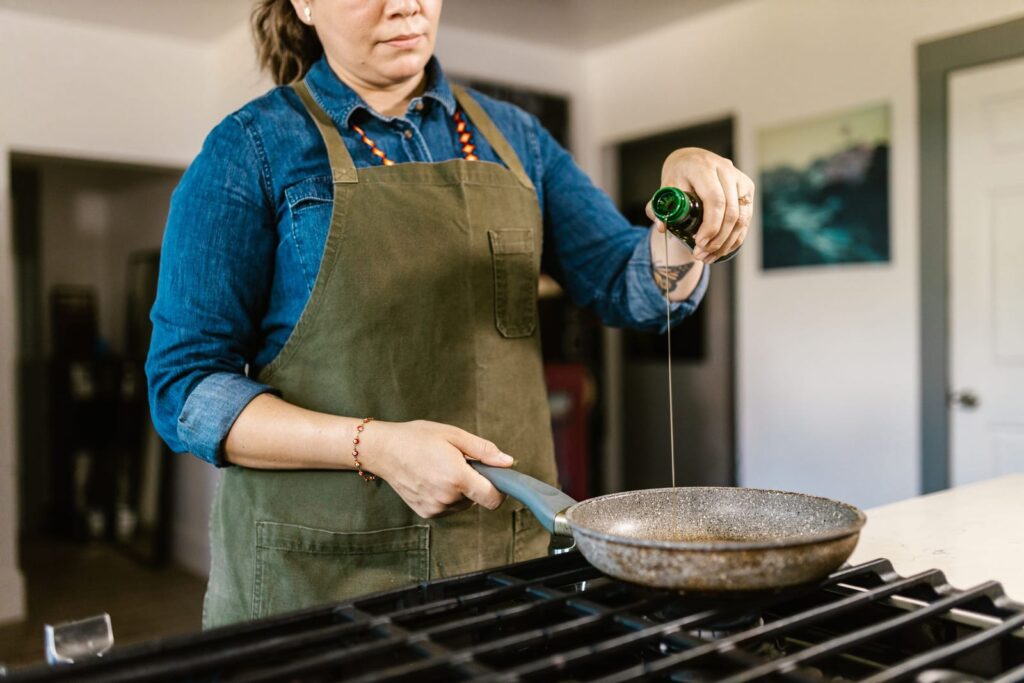
Few kitchen myths are as stubborn as the idea that you should never fry with olive oil. It has a low smoke point, the argument goes, so heating it turns it harmful and bitter. Walk into a kitchen in Spain, Greece or southern Italy, though, and you will find cooks frying everything from potatoes to fish in olive oil, as their families have for generations. So who is right? The short answer is that olive oil, including extra virgin, is perfectly suitable for most frying. The longer answer is more interesting, and it starts with what a smoke point actually tells you.
What is a smoke point?
An oil’s smoke point is the temperature at which it starts to give off a continuous stream of visible smoke. At that point the oil is breaking down: fats are degrading, free fatty acids and other compounds are being released, and flavor turns acrid. Cooking far past the smoke point is a bad idea for taste and for your smoke alarm.
But smoke point is not a fixed property of a type of oil. It varies with the quality, freshness and refinement of each bottle. An oil with more free fatty acids, which is typical of lower quality or older oil, smokes at a lower temperature. A fresh, high-quality oil smokes later.
The numbers for olive oil
According to the North American Olive Oil Association, the trade body for olive oil in the US and Canada, typical smoke points are:
| Type of olive oil | Typical smoke point |
|---|---|
| Extra virgin olive oil | 350 to 410°F (about 177 to 210°C) |
| Refined olive oil (often sold as “light” or “pure” olive oil) | 390 to 470°F (about 199 to 243°C) |
Compare that with the temperatures you actually cook at. General stovetop sautéing sits around 350°F (177°C). Deep frying is usually done between 350 and 375°F (177 to 190°C), the range most recipes call for to get a crisp exterior without a greasy center. A good extra virgin olive oil covers most of that range, and refined olive oil covers all of it with room to spare.
Why smoke point is not the whole story
The more important question is not “when does this oil smoke?” but “how well does this oil resist breaking down while I cook with it?” That property is called oxidative stability, and it is where olive oil does surprisingly well.
Two things make olive oil stable under heat:
- Its fat profile. Olive oil is mostly monounsaturated fat. Monounsaturated fats are much more resistant to oxidation than the polyunsaturated fats that dominate many seed oils, such as sunflower, corn and soybean oil.
- Its natural antioxidants. Extra virgin olive oil is unrefined, so it keeps polyphenols and vitamin E. These compounds protect the oil from breaking down and from forming free radicals as it heats.
Research backs this up. A 2013 study by Tomassetti and colleagues, published in the journal Food Chemistry, compared extra virgin olive oil with peanut oil during heating and found that more heat was needed to start the oxidation process in the extra virgin olive oil, even though peanut oil has a higher published smoke point.
In other words, an oil with a high smoke point but a fragile fat profile can degrade more during a long fry than olive oil does, even if it has not visibly started to smoke.
So can you fry with olive oil?
Yes. Here is how the different types fit different kinds of cooking:
- Sautéing, pan frying and roasting: extra virgin olive oil is an excellent choice. It adds flavor, holds up well at these temperatures, and is the everyday cooking fat of the Mediterranean diet.
- Shallow frying: both extra virgin and refined olive oil work. Keep the heat moderate and do not let the pan smoke before adding food.
- Deep frying: perfectly possible with either. Refined olive oil is often the practical pick for deep frying because it is milder in flavor, cheaper per liter and has the higher smoke point. Extra virgin gives a distinctive fruity flavor to things like fried potatoes or battered fish, if you do not mind the cost of filling a pot.
- Searing at very high heat: if you want a ripping hot pan for a steak, a refined olive oil or another high smoke point oil gives you more margin.
What “light” olive oil really means
“Light” on an olive oil bottle refers to color and flavor, not calories. Light olive oil is refined olive oil, sometimes blended with a little virgin oil, and it has exactly the same fat and calorie content as extra virgin, roughly 120 calories per tablespoon. What it lacks is the peppery, grassy flavor and most of the polyphenols. That neutral taste and higher smoke point are why it is popular for baking and frying.
Tips for frying well with olive oil
- Use a thermometer. A clip-on deep fry thermometer takes the guesswork out. Keep the oil between 350 and 375°F for most foods.
- Do not preheat the oil to smoking. If you see smoke, the pan is too hot. Pull it off the heat and let it come down before adding food.
- Dry your food. Water on the surface of food makes hot oil spatter and drops the temperature suddenly.
- Fry in batches. Crowding the pan drops the oil temperature, so food absorbs more oil and comes out soggy rather than crisp.
- Buy fresh oil and store it well. Heat, light and air all push oil toward rancidity and lower its smoke point. Keep bottles sealed, in a dark cupboard away from the stove.
Can you reuse olive oil after frying?
You can, within limits. Let the oil cool, strain it through a fine sieve or a coffee filter to remove crumbs and batter, and store it in a sealed jar in a cool, dark place. Each round of frying breaks the oil down a little more, so it will start to smoke at lower temperatures, darken and develop off flavors. Discard it when it smells stale or fishy, looks dark and thick, or foams heavily when heated. We cover this in more detail in Can Cooking Oil Be Reused?
The verdict
Olive oil’s reputation as an oil you must never heat does not hold up. Extra virgin olive oil smokes at around 350 to 410°F, refined olive oil at around 390 to 470°F, and everyday frying happens between 350 and 375°F. More importantly, olive oil’s monounsaturated fat and natural antioxidants make it one of the more stable oils under heat. Fry with it, sauté with it, roast with it. Just use a fresh bottle, keep an eye on the temperature, and stop before the pan starts to smoke.